
What is AI Search Optimisation (AISO)? A plain-English guide
AISO is the practice of getting your business named, quoted, or linked when someone asks ChatGPT, Gemini, or Perplexity a question instead of typing it into Google. Here's how it actually works.
 Dr Koliya Wedanage(updated )6 min read
AI Search Optimisation (AISO) is the practice of making sure your business gets named, quoted, or linked when someone asks an AI system a question instead of typing it into Google: "best CRM for a small agency," "physio near me that takes new patients," "is [your competitor] any good." You've spent twenty years learning how to rank. AISO is the equivalent skill for a search box that no longer returns ten blue links, just one answer, with your name in it or not.
You'll also see this called GEO (Generative Engine Optimisation) or AEO (Answer Engine Optimisation). They overlap almost completely. GEO comes out of the research community and emphasises how content is structured to be retrieved and quoted; AEO comes out of the marketing community and emphasises getting cited and mentioned. AISO is Coderra's name for doing both, deliberately, for one business.
Why this is happening faster than SEO did
Three numbers explain the urgency:
- ChatGPT alone passed 900 million weekly active users in February 2026, more than double the 400 million it had a year earlier (OpenAI, via TechCrunch).
- Google's AI Overviews now appear on more than 20% of all Google searches and, according to Ahrefs click-through data cited in a June 2026 SparkToro/Similarweb study, cut click-through to websites by roughly 60% when they show up.
- As a result, 68% of US Google searches in early 2026 ended without a single click to any website, up from 60% just two years earlier. For every 1,000 searches, only around 276 clicks now reach the open web.
None of that means search demand disappeared. It means the answer is increasingly assembled and delivered before your website gets a chance to earn the click, which makes it a much bigger problem if your business isn't part of that assembled answer.
How an AI engine actually decides what to cite
It helps to know the three steps happening behind every AI answer, because each one is a different place your business can succeed or fail.
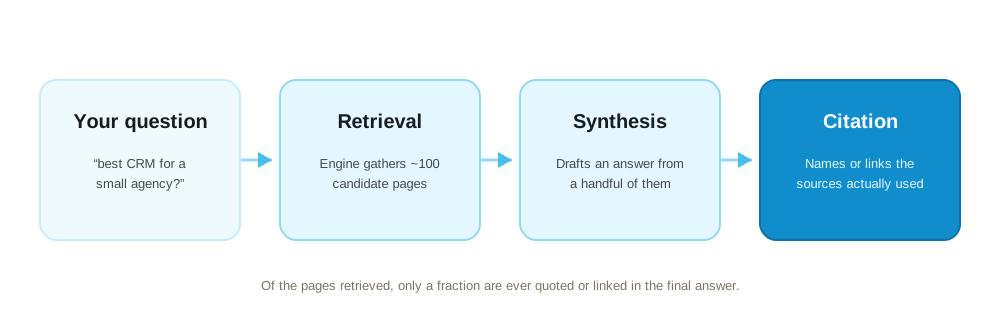
- Retrieval: the engine gathers a pool of candidate pages that seem relevant to the question (often around a hundred).
- Synthesis: it drafts an answer using a much smaller handful of those pages.
- Citation: it names, quotes, or links the sources that actually shaped the answer the person reads.
The gap between steps 1 and 3 is the whole game. Independent instrumentation of ChatGPT has found the engine retrieves roughly 100 pages per query but only around 15% of those ever make it into the visible answer. The rest were "in the running" and never mentioned again. Ranking highly in retrieval doesn't help if your content doesn't survive synthesis.
The best evidence on what survives synthesis comes from the researchers who coined the term GEO: a 2024 Princeton and IIT Delhi study (Aggarwal et al., presented at KDD 2024) ran a 10,000-query benchmark testing which content changes actually increased citation rates. The tactics that worked were unglamorous and specific: adding credible citations and sources lifted a page's citation rate by up to 115%, adding direct quotes by up to 43%, and adding named statistics by up to 33%. None of that is a technical trick. It's the same thing that's always made content trustworthy, done deliberately, for an audience of one AI reader as well as a human one.
Two things that don't move the needle
Google's own May 2026 guide, Optimizing your website for generative AI features on Google Search, explicitly lists these as things you can stop worrying about: special "AI" schema markup ("there's no special schema.org markup you need to add") and llms.txt (Google states it "doesn't negatively or positively impact your visibility or rankings" in Search). Multiple independent 2026 crawler audits back this up: GPTBot, PerplexityBot, and Google-Extended overwhelmingly skip /llms.txt and read your rendered HTML directly. It's worth publishing for a different reason (AI coding agents like Cursor and Claude Code use it to navigate developer docs), but treat it as good hygiene, not a citation strategy.
SEO vs AISO: what actually changes
| Dimension | Traditional SEO | AISO |
|---|---|---|
| The prize | A ranking position among ten (or more) results | Being one of a handful of sources an answer is built from |
| Success looks like | A click to your website | A mention, quote, or link inside someone else's answer, sometimes with no click at all |
| Core lever | Keywords, backlinks, page speed, technical crawlability | Clear, well-sourced, directly-answering content an engine can safely quote |
| Measurement | Rank position, organic traffic | Share of voice across AI engines: are you mentioned, and how are you described? |
| Timeframe | Weeks to months, driven by crawl and index cycles | Can shift within a single re-generation of an answer as an engine re-retrieves |
Neither replaces the other. Google's own guidance is blunt about this: "the best practices for SEO continue to be relevant because our generative AI features on Google Search are rooted in our core Search ranking and quality systems." A page that's already technically sound, genuinely helpful, and clearly attributed to a real business has a head start on both fronts. AISO adds the layer on top: writing and structuring specifically to be the source an AI engine is confident enough to quote.
What actually helps
Stripped of hype, the levers that both Google's guidance and the independent research agree on are:
- Answer the question directly and early. An engine synthesising an answer favours a source that states the answer plainly, not one that makes the reader (or the model) hunt for it.
- Back claims with real specifics: named numbers, direct quotes, dates. This is the single most-tested lever in the GEO research above.
- Make your entity unambiguous. Google's guide specifically calls out "entity clarity", meaning it's obvious who you are, what you cover, and how your brand relates to the topic, as something that matters for AI features. Consistent business details, a real
Organizationschema, and clear authorship all feed this. - Keep the basics working: crawlable pages, fast load times, content that's actually in text (not locked inside an image or a video with no transcript).
- Show up in the sources AI engines already trust: industry publications, review sites, forums, and your own site, consistently telling the same accurate story about your business.
That last point is why AISO can't be a one-off audit. It's a loop: know what AI engines currently say about you, fix the specific gaps, and check again, because the "answer" is being regenerated constantly, not indexed once a month.
See what AI already says about your business.
AISO runs a free scan across ChatGPT, Gemini, Claude, and Perplexity and shows you exactly where the gaps are.
If you want the deeper version of this, including how to actually score and choose between the growing list of tools that measure this stuff, see our buyer's guide to AI search visibility tools. If monitoring alone won't close the gap for you, read why execution wins it back. And if you'd rather see the platform than read about the theory, AISO is Coderra's answer to everything above: one place that scans, scores, and closes these gaps for you.
Co-Founder & CTO

